The State of SagaBound: July 2026
Three game modes, permanent death on real dice, a sharper storyteller, and steadier turns: what shipped in SagaBound this summer, and what left.
This summer turned SagaBound from one game into three. Adventure got a sharper storyteller and steadier turns, Storyteller mode stripped the mechanics away for pure narrative play, and Tabletop entered early access with real dice, sworn vows, and permanent death. Here is what shipped, what we retired, and what we are working on now.
Three ways to play
Every new saga now starts by choosing a mode. Adventure is the classic experience: combat, health, quests, and money, with the narrator keeping score. Storyteller removes stats, combat, and the quest log entirely for players who want the story and nothing else, while the codex, story memory, scene art, and voice narration keep working underneath. Tabletop is the big one: a dice-driven mode built on the Ironsworn tabletop system, rolling out in early access to Paragon members first.
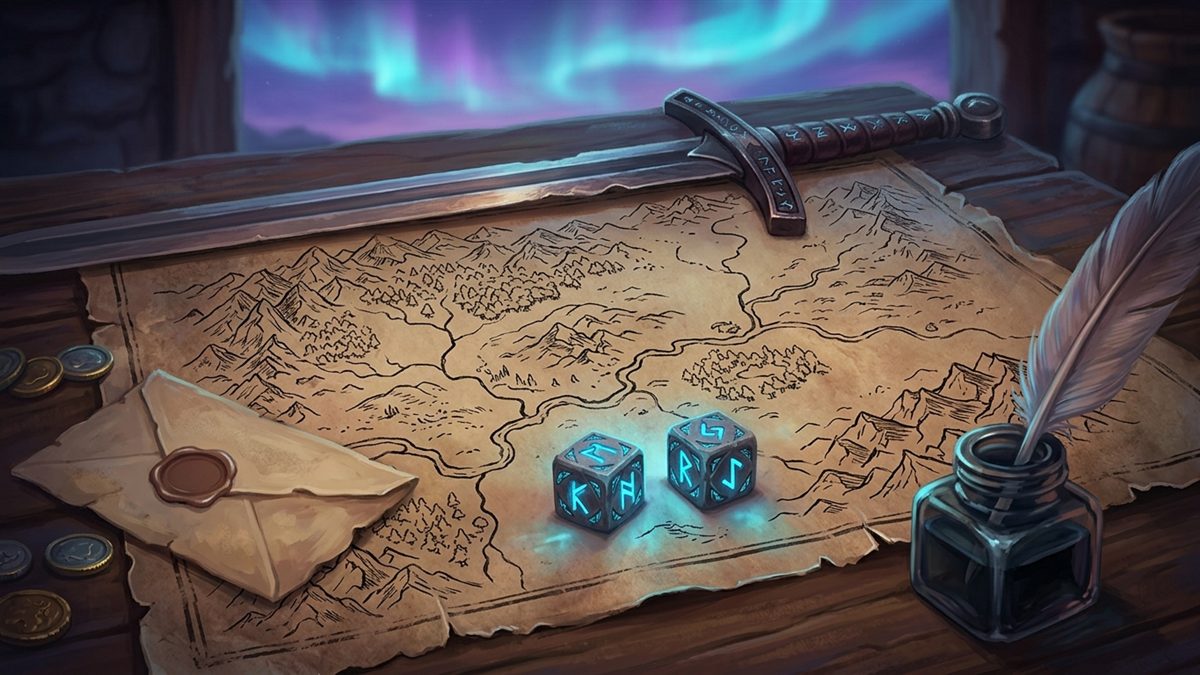
Tabletop plays by table rules. Five stats, one six-sided action die against two ten-sided challenge dice, all rolled on the server, and a narrator that is bound by the result instead of deciding it. Momentum banks your wins and can be burned to flip a miss before it is written into the story. Quests are sworn vows with progress tracks that pay experience, experience buys asset cards, and death is real: miss the Face Death roll at zero health and that character's story ends permanently. Fantasy genres play classic Ironsworn and science fiction plays Starforged, picked automatically from your saga's genre. The full rules live in the Tabletop guide article, along with the Creative Commons credits for Shawn Tomkin's Ironsworn material the mode is built on.
A sharper storyteller
Mid-July's storyteller release was about the Dungeon Master earning trust. It plants small threads and pays them off later. It warns you before a serious or deadly blow instead of springing it from nowhere. Suggested next moves are now genuinely different paths labeled with their true risk, rather than three versions of the same move. The story leans toward what you reach for, action, conversation, or exploration, and stops manufacturing conflict when you want a quiet moment. Waiting cuts straight to the moment something changes. And corrections stick: a fix you apply through Correct the DM now carries forward instead of quietly reverting a turn later.
Correct anything
Correct the DM grew from fixing names and facts into a full repair kit. It can restore an item that vanished, set your money, health, or location right, fix what is equipped, mend a relationship the game got wrong, reopen a quest that failed unfairly, and bring back a character the story wrongly killed, always showing you exactly what will change before you confirm. Alongside it, the world itself got more solid: dropped items stay where you left them, drawn weapons are acknowledged in the next scene, and departed ships stop reading as still docked.
Memory kept growing
The free plan's active context grew 50 percent, from 8,000 to 12,000 tokens, and every tier keeps more of the recent story in front of the narrator. Underneath, long-term recall became searchable by meaning, so a person or promise from hundreds of turns ago resurfaces when it matters even if nobody repeats the exact words, and the rolling summary now re-checks itself against what actually happened as it compresses. How the memory layers fit together is covered in the memory and codex guide.
Models: what joined, and what left
The scene-art roster doubled with Nano Banana 2 and Nano Banana 2 Lite joining FLUX.2 Pro and FLUX.2 Klein, and every plan can use any image model. On the storyteller side, two roleplay-tuned models launched for Architect and Paragon: Aion 3.0 and Aion 3.0 Mini. One day later we retired Aion 3.0. It was far more expensive to run than the rest of the lineup, the math did not work, and pretending otherwise would have meant quietly degrading something else to pay for it. Aion 3.0 Mini stayed, everyone who had picked the larger model was moved to it automatically, and the changelog records the whole episode. That is how roster decisions will keep being made: tested in the open, and reversed in the open when the numbers say so.
Quality of life
- Settings was rebuilt around two tabs, Story and App, with collapsible groups that show their values at a glance.
- The voice narrator starts speaking almost as soon as words appear, and Settings gained speed and volume controls for it.
- Creators can publish a world as Unlisted: only people with the link can find and play it.
- Quests complete the moment their final objective is done, and stranded quests heal themselves on the next turn.
- Free daily turns reset at one midnight everywhere instead of two clocks disagreeing.
- The Community tab pages through the full world catalog, and world cover art loads at a fraction of its old size.
What we are working on now
Widening Tabletop early access beyond Paragon. An Android app headed for the Play Store. And the research series this blog was partly built for: aggregate, anonymized studies of how people actually play AI-driven tabletop RPGs. No dates on any of it, because dates we are not sure of are how roadmaps rot.